
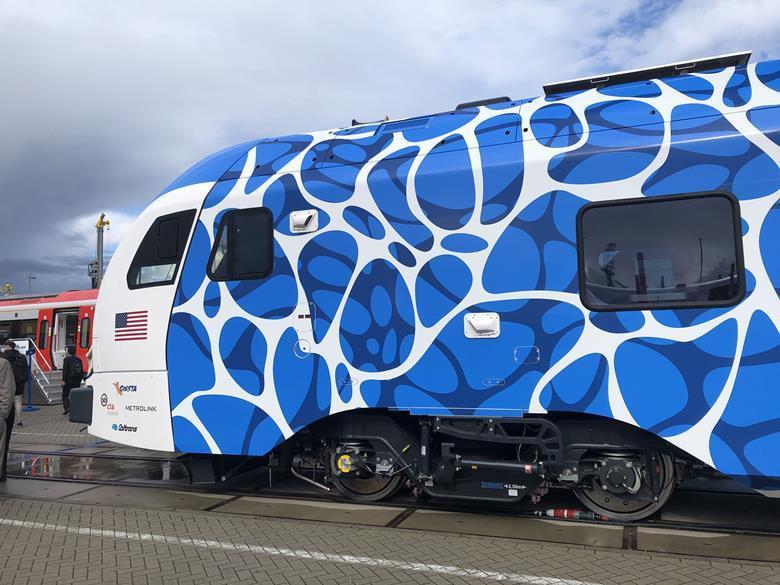
Hydrogen-Powered Rail: Clean Energy on Familiar Tracks
The Hydrogen Commuter Rail Initiative builds on the promise of sustainable transport by using a propulsion technology that merges the best of both worlds — the efficiency of electric rail and the flexibility of diesel — without the need for expensive overhead power infrastructure.
Hydrogen trains operate quietly, cleanly, and efficiently, drawing energy from onboard fuel cells that produce only water vapor as a byproduct. The technology is mature, commercially proven in Europe and Japan, and now ready for regional commuter rail applications in the United States.
1. Hydrogen Power 101: How It Works
Hydrogen-powered trains use fuel cell electric propulsion, a system that converts stored hydrogen gas into electricity on demand.
Here’s how it functions:
Hydrogen Storage:
Compressed hydrogen is stored onboard the train in high-pressure tanks (typically 350–700 bar).
Electricity Generation:
Hydrogen from the tank enters a fuel cell stack, where it reacts with oxygen from ambient air through an electrochemical process — not combustion.
The reaction generates direct current (DC) electricity, water vapor, and heat.
Power Distribution:
The electricity produced feeds into a traction converter that powers the electric traction motors on the train’s axles. Excess energy can also charge onboard lithium-ion batteries, which supply acceleration power and store braking energy through regenerative braking.
System Efficiency:
Overall efficiency (tank-to-wheel) reaches 40–60%, comparable to modern electric rail and significantly higher than diesel combustion engines (~30–35%).
Modular Design:
Because all energy systems are onboard, the train operates independently of overhead wires or trackside power — making it ideal for existing freight corridors where electrification is impractical.
This hybrid electric-hydrogen system essentially turns each train into its own mobile power plant — one that carries its fuel, generates its own electricity, and emits only clean water vapor.
2. No Overhead Wiring: Electrification Without the Grid
Traditional electric rail systems require a vast network of overhead lines (catenary) and substations to supply high-voltage current.
Installing these systems is expensive and disruptive, especially along active freight routes.
Hydrogen eliminates that need entirely.
Advantages of Onboard Energy Storage
The absence of overhead wiring is especially advantageous for routes like Colorado Springs–Denver, where freight lines pass through diverse terrain, overpasses, and mixed-use zones. Electrifying such corridors would require major reconstruction.
Hydrogen power sidesteps that challenge, enabling modern rail electrification without touching the wires.
3. Safety and Refueling
Hydrogen rail systems have already proven their safety in years of service overseas. The technology borrows heavily from aerospace-grade storage and handling systems.
Hydrogen Storage Safety
Refueling Infrastructure
In the long term, hydrogen supply could be co-located with renewable energy sources, such as wind or solar farms, creating a fully carbon-neutral ecosystem.
4. Environmental Gains
Hydrogen propulsion offers the cleanest rail energy pathway available today.
These benefits align directly with federal and state clean transport goals, including:
Together, these policies create a fertile environment for public–private investment in hydrogen rail corridors.
5. Comparative Analysis: Diesel vs Electric vs Hydrogen
Below is a conceptual overview of the three major commuter rail propulsion options.
(Values are representative of current 2024 U.S. averages and serve as indicative estimates.)
| Parameter | Diesel-Electric | Overhead Electric | Hydrogen Fuel Cell |
|---|---|---|---|
| Infrastructure Cost | $10–15M per mile (new track + upgrades) | $20–25M per mile (catenary + substations) | $10–12M per mile (no catenary) |
| Operating Energy Cost | $0.25–0.30 per seat-mile | $0.20–0.25 per seat-mile | $0.22–0.26 per seat-mile |
| CO₂ Emissions | 90–100 g/pkm | 0 g/pkm | 0–5 g/pkm (depending on H₂ source) |
| Noise (dB) | 85–90 | 75–80 | 75–80 |
| Fuel Source | Diesel | Electric Grid | Hydrogen |
| Maintenance Complexity | High | Medium | Low–Medium |
| Electrification Required | None | Extensive | None |
| Refueling / Charging Time | 15–20 minutes | Continuous power | 15–20 minutes |
| Environmental Impact | High | Low | Very Low |
Key Takeaways
Looking Ahead
Hydrogen propulsion represents a practical evolution of rail electrification — one that uses proven components, existing tracks, and modular fueling infrastructure.
It’s a technology that bridges today’s freight rail network with tomorrow’s zero-emission goals.
For corridors like Colorado Springs–Denver, hydrogen offers not only a cleaner and quieter commute but also a strategic advantage: it turns the region’s existing infrastructure into a ready-made, 21st-century transit corridor — without billions in new construction.
The result is a scalable, sustainable model that can be replicated across the country, one line at a time — connecting cities, protecting the environment, and redefining the future of regional mobility.

