
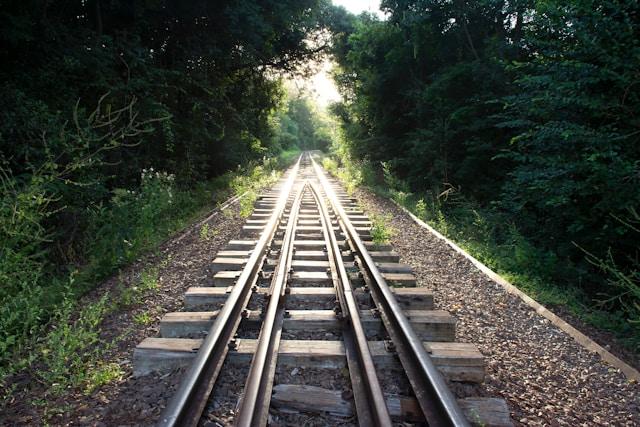
Train tracks converging through a tree-lined corridor, symbolizing connected communities.

The Concept

Reusing Freight Corridors for a New Generation of Commuter Rail

Across America’s fast-growing regional corridors, the demand for affordable, sustainable, and dependable daily travel continues to rise. Metropolitan areas are expanding beyond traditional commuting ranges, pushing the limits of highways and existing transit systems.

Rather than building entirely new railways — a process that can take decades and cost billions — a smarter path lies before us: reusing the existing freight rail infrastructure that already connects these cities. This approach opens the door to rapid deployment of clean, intercity commuter trains.

1. The Problem: Congestion & Cost

Highway expansion offers diminishing returns, and conventional commuter rail proposals often face insurmountable capital hurdles. While the need is clear, the cost and time to build new systems have held back progress.

Key Barriers

High Electrification Costs

Installing overhead catenary can cost $4–6 million per mile, a major financial barrier.

Right-of-Way Acquisition

New rail corridors can take 10–20 years to negotiate, permit, and acquire.

Public Funding Competition

Budgets often prioritize larger intercity projects, leaving regional lines underfunded.

2. The Solution: Shared Infrastructure

The U.S. freight network is a vast, existing asset. By using low-traffic segments for passenger service, we dramatically reduce costs and accelerate deployment.

Shared-Use Corridors

Operate passenger trains on UP tracks in predefined windows, avoiding freight interference.

Targeted Upgrades

Focus investment on critical points like sidings, signals, and crossings to meet passenger standards.

Localized Stations

Build small, modular platforms near population hubs to minimize land and construction costs.

Alternative Power Trains

Use self-contained hydrogen propulsion, eliminating the need for expensive overhead wires.

3. The Operating Model

The service model is designed for efficiency, reliability, and the modern commuter.

Frequency

  • 3 morning departures
  • 3 evening returns
  • Timed for peak commuting hours

Speed & Length

  • 70–100 mile typical route
  • 65–75 mph average speed
  • ~80 minute end-to-end travel

Fleet & Facilities

  • Small fleet of 3–5 trainsets
  • Light maintenance depot
  • Use of existing UP sidings

Passenger Experience

  • Simple, accessible stations
  • Digital ticketing & Wi-Fi
  • Last-mile transit integration

4. Case Study: Colorado Front Range

The I-25 corridor between Colorado Springs and Denver provides an ideal proving ground for this concept, connecting over 1 million residents.

70

Miles

1M+

Residents

100+

Mins by Car

~80

Mins by Train

Colorado Springs ↔ Castle Rock ↔ Lone Tree ↔ Denver Union Station

5. A Scalable, Cost-Effective Template

Low Capital Cost

Avoids up to 70% of new rail project costs by using existing corridors.

Minimal Impact

Limits ecological disturbance and accelerates permitting by staying in established rights-of-way.

Rapid Implementation

Projects can become operational in 3-5 years, not 10-15.

Scalable Framework

The model is a template that can be replicated on other routes nationwide.

Funding Alignment

Qualifies for multiple federal and state clean transport funding programs.

Community Benefits

Stimulates regional economies and provides equitable transport access.

By focusing on what already exists, we can transform regional travel from a long-term aspiration into an immediate opportunity. It’s not a distant vision — it’s already on track.

Explore Technology Solutions