
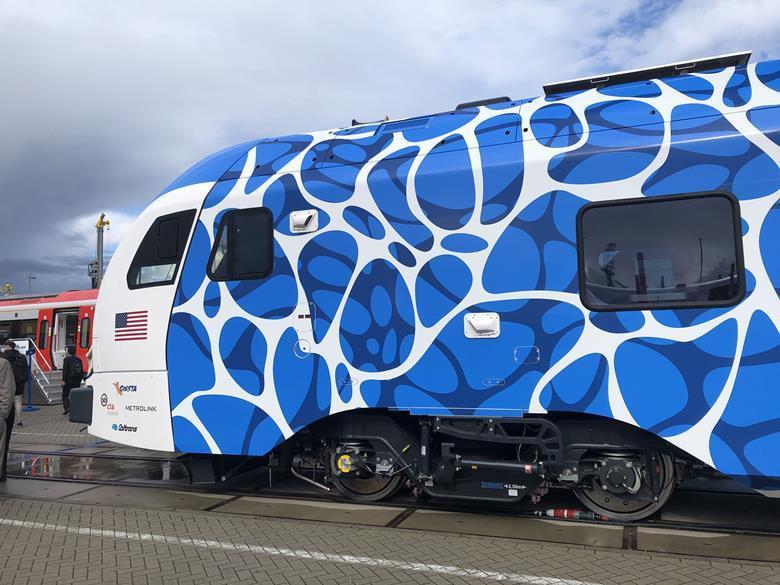
A Stadler FLIRT hydrogen-powered train with distinctive blue and white livery.

Technology

Hydrogen-Powered Rail: Clean Energy on Familiar Tracks

The Hydrogen Commuter Rail Initiative builds on the promise of sustainable transport by using a propulsion technology that merges the best of both worlds — the efficiency of electric rail and the flexibility of diesel — without the need for expensive overhead power infrastructure.

Hydrogen trains operate quietly, cleanly, and efficiently, drawing energy from onboard fuel cells that produce only water vapor as a byproduct. The technology is mature, commercially proven in Europe and Japan, and now ready for regional commuter rail applications in the United States.

1. Hydrogen Power 101: How It Works

Hydrogen-powered trains use fuel cell electric propulsion, a system that converts stored hydrogen gas into electricity on demand. Here’s how it functions:

Hydrogen Storage & Generation

Compressed hydrogen is stored in high-pressure tanks.

In the fuel cell, hydrogen reacts with oxygen to generate DC electricity, water, and heat.

Power Distribution

Electricity powers traction motors on the train’s axles.

Excess energy charges onboard batteries, also used for acceleration and storing braking energy.

System Efficiency

Overall tank-to-wheel efficiency reaches 40–60%.

Significantly higher than diesel combustion engines (~30–35%).

Modular Design

All energy systems are onboard, operating independently of wires.

Each train is a mobile power plant emitting only clean water vapor.

2. No Overhead Wiring: Electrification Without the Grid

Traditional electric rail systems require a vast network of overhead lines (catenary) and substations. Hydrogen eliminates that need entirely.

Advantages of Onboard Energy Storage

No Catenary Installation

Avoids $4–6 million per mile in capital cost.

Simplified Permitting

No major visual or land-use impact from overhead wires.

Rapid Deployment

Uses the same tracks and clearance standards as diesel.

Resilient Operation

Not dependent on grid availability or regional power outages.

3. Safety and Refueling

Hydrogen rail systems have already proven their safety in years of service overseas. The technology borrows heavily from aerospace-grade storage and handling systems.

Hydrogen Storage Safety

Cylinders are built to withstand fire, impact, and puncture tests.

Automated leak detection, pressure monitoring, and controlled venting ensure safety.

Refueling Infrastructure

A refueling cycle takes 15–20 minutes, similar to diesel.

Depots can receive hydrogen via trailers or generate it on-site with renewables.

4. Environmental Gains

Zero Tailpipe Emissions

The only output is pure water vapor, with no particulates, CO₂, or nitrogen oxides.

Noise Reduction

Electric traction is substantially quieter, improving urban livability.

Lifecycle Carbon Savings

Up to 70% lower emissions than diesel, approaching zero with green hydrogen.

Energy Recovery

Regenerative braking recaptures up to 25% of energy for reuse.

5. Comparative Analysis: Diesel vs. Electric vs. Hydrogen

Below is a conceptual overview of the three major commuter rail propulsion options. Values are representative of current 2024 U.S. averages and serve as indicative estimates.

ParameterDiesel-ElectricOverhead ElectricHydrogen Fuel Cell
Infrastructure Cost$10–15M per mile (new track + upgrades)$20–25M per mile (catenary + substations)$10–12M per mile (no catenary)
Operating Energy Cost$0.25–0.30 per seat-mile$0.20–0.25 per seat-mile$0.22–0.26 per seat-mile
CO₂ Emissions90–100 g/pkm0 g/pkm0–5 g/pkm (depending on H₂ source)
Noise (dB)85–9075–8075–80
Fuel SourceDieselElectric GridHydrogen
Maintenance ComplexityHighMediumLow–Medium
Electrification RequiredNoneExtensiveNone
Refueling / Charging Time15–20 minutesContinuous power15–20 minutes
Environmental ImpactHighLowVery Low
Key Takeaways

Hydrogen achieves near-parity with electric rail efficiency—without the infrastructure.

Lifecycle cost is 40–50% lower than traditional catenary-based systems.

The technology is modular and ideal for mixed-use freight corridors.

Ready to Learn More?

Explore how hydrogen technology can transform regional transportation in your area.

Contact Our Team